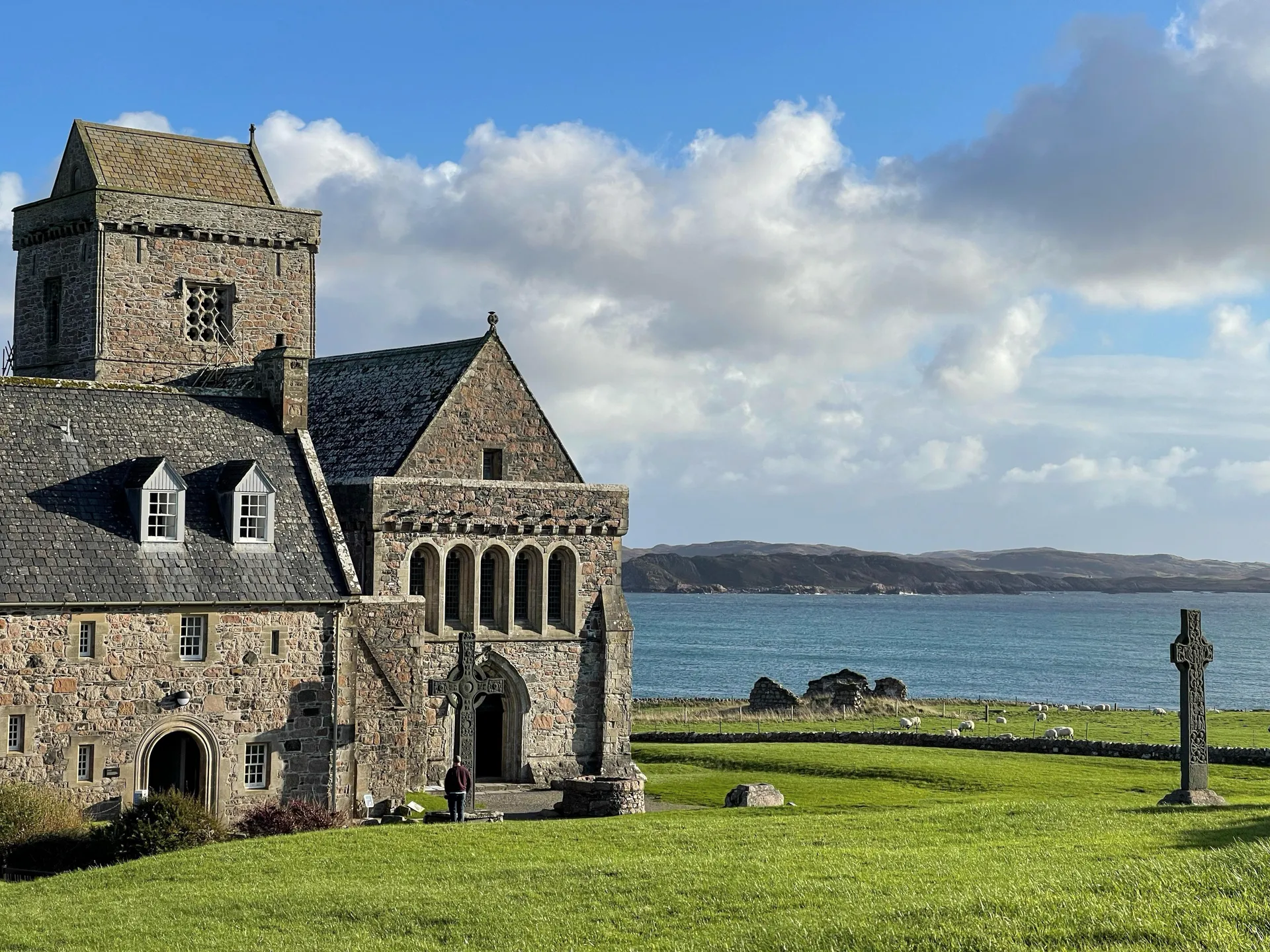
In 563 AD, the Irish monk Columba crossed the sea from Ireland with twelve companions and established a monastery on this slender isle off the western coast of Scotland — a foundation that would become one of the most important centres of early Christianity in all of Europe. From Iona's scriptorium came the Book of Kells, that supreme masterwork of Insular art, begun here before Viking raids forced its relocation to Ireland in the ninth century. The Benedictine abbey that stands today, painstakingly restored in the twentieth century, rises from those ancient foundations like a prayer carved in stone, its weathered pink granite walls holding more than fourteen centuries of devotion.
Barely three miles long and one mile wide, Iona possesses a luminosity that has drawn pilgrims, poets, and painters since long before tourism existed. The light here is extraordinary — a crystalline Atlantic radiance that shifts from silver to gold across beaches of white shell sand so fine they could pass for Caribbean shores, were it not for the wild thrift and sea campion nodding in the Hebridean wind. The village of Baile Mòr clusters around the abbey with a handful of whitewashed cottages, a single general store, and the kind of silence that urban travellers have forgotten exists. Forty-eight Scottish kings, including Macbeth, are said to lie in the Reilig Odhráin burial ground — a fact that gives even a casual stroll through the graveyard the gravity of walking through the pages of history itself.
The table on Iona is shaped by sea and croft. At the Argyll Hotel, langoustines pulled from the Sound of Iona that morning arrive simply grilled with drawn butter and a scatter of wild garlic gathered from the abbey grounds. Cullen skink — that supremely comforting smoked haddock chowder of the Scottish coast — appears on most menus alongside hand-dived Mull scallops seared with black pudding from Stornoway. For something sweet, seek out cranachan, the traditional Highland dessert of whipped cream layered with toasted oatmeal, heather honey, and whisky-soaked raspberries. The island's proximity to Mull and its celebrated Tobermory Distillery means a dram of single malt is never far from hand, ideally taken on the machair grasslands as the sun sets behind the Treshnish Isles in a blaze of copper and violet.
Iona's position in the Scottish archipelago makes it a natural starting point for wider exploration of Britain's most storied landscapes. The sailing route south passes the dramatic coastline of Cornwall, where the ancient harbour town of Fowey spills down wooded hillsides to a river mouth that once sheltered merchant fleets. Further afield, Bangor in North Wales offers a gateway to Belfast and the wild beauty of the Antrim coast, while the limestone village of Grassington in the Yorkshire Dales presents England's pastoral heart at its most refined. Even Stonehenge, that eternal enigma on the Salisbury Plain, falls within the reach of an extended British Isles itinerary — a pairing that connects Celtic spirituality with Neolithic mystery across four thousand years.
Iona's intimate scale and tender-access approach make it a prized port of call for expedition and luxury cruise lines navigating the British Isles. Azamara and Oceania Cruises position calls here within their immersive Scottish itineraries, while Cunard and P&O Cruises bring a distinctly British sensibility to Hebridean waters. Princess Cruises and Carnival Cruise Line open Iona to a broader audience without diminishing its mystique, and Regent Seven Seas Cruises and Seabourn treat the island as the jewel it is within their ultra-luxury Scottish programmes. HX Expeditions brings purpose-built expedition vessels close to shore, and Viking, with its culturally rich itineraries, frames Iona within the broader narrative of Norse and Celtic Britain — a layering of stories that makes every arrival feel less like a port call and more like a pilgrimage.